Payment Processing Statement Audit: The Fees You Should Look For
Most business owners know their payment processor charges a percentage of every credit card transaction. What many don’t realize is that the advertised processing rate may represent only part of what they actually pay.
Monthly fees, authorization charges, PCI fees, statement fees, gateway charges, equipment costs, and other line items can significantly affect the true cost of accepting credit cards.
That is why periodically auditing your merchant processing statement is important.
A payment processing statement audit can help you understand exactly where your money is going, identify fees that deserve a closer look, and determine your effective processing rate.
Start With Your Effective Rate
Before examining individual fees, calculate your effective rate.
Your effective rate measures what you actually paid compared with the amount you processed.
Effective Rate = Total Processing Fees ÷ Total Card Sales × 100
For example, suppose your business processed $100,000 in card transactions during the month and your total processing costs were $3,600.
Your effective rate would be:
$3,600 ÷ $100,000 = 3.60%
This number can be much more useful than focusing only on an advertised rate.
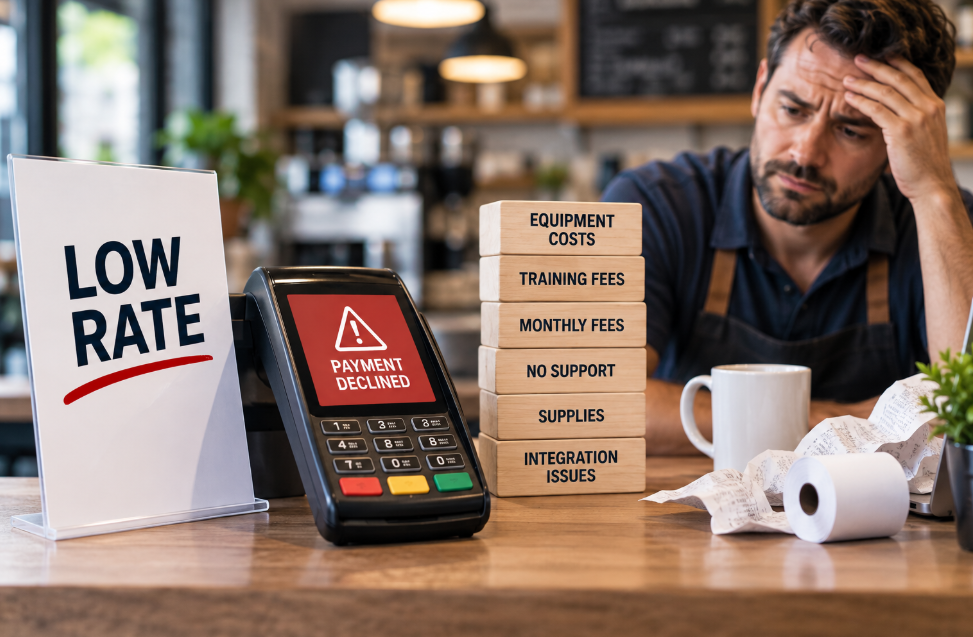
A processor might advertise a low percentage while additional transaction fees, monthly charges, equipment expenses, gateway fees, and other costs increase what the merchant ultimately pays.
The goal of a statement audit is to understand the entire cost structure.
1. Interchange Fees
Interchange is a fundamental component of card processing costs.
These fees are generally associated with the card type, transaction characteristics, and how the transaction qualifies under the applicable card-network rules.
A rewards credit card, commercial card, debit card, online transaction, and manually entered transaction may not carry the same underlying costs.
During an audit, look at how transactions are being categorized.
If a large percentage of your transactions are falling into more expensive categories, the issue may not necessarily be your processor’s markup. Transaction method, card mix, data quality, or how your payment system is configured can also affect costs.
A knowledgeable processor should be able to help explain what you’re seeing.
2. Processor Markup
Interchange and card-network costs are not necessarily the same thing as your processor’s markup.
Your processor may charge additional amounts through percentage-based fees, per-transaction charges, monthly fees, or a combination of these.
This distinction is important when comparing processors.
Instead of simply asking:
“What rate are you offering me?”
Ask:
“What is your markup, and what other fees will I pay in addition to the underlying card costs?”
That question can produce a much more meaningful comparison.
3. Per-Transaction and Authorization Fees
Small transaction fees can become substantial for high-volume merchants.
Imagine a business processes 10,000 transactions every month.
An additional $0.05 per transaction represents:
10,000 × $0.05 = $500 per month
That’s $6,000 per year.
Look for charges described as:
- Authorization fees
- Transaction fees
- Capture fees
- Settlement fees
- AVS fees
- Network authorization charges
Individually, these amounts may appear insignificant. At scale, they can materially affect your processing expense.
4. Monthly Account Fees
Processing statements may contain recurring charges that aren’t directly connected to individual transactions.
Depending on your processing arrangement, you may encounter fees for account services, statements, platforms, reporting, gateways, or other services.
The important question isn’t simply whether a monthly fee exists.
Ask:
What am I receiving for this fee?
Some recurring charges pay for services your business actively uses. Others may warrant additional review.
5. PCI-Related Fees
Payment Card Industry Data Security Standard requirements are an important part of accepting card payments.
Your statement may contain PCI-related charges.
Pay particular attention to PCI non-compliance fees.
If you’re being charged because your account is considered non-compliant, determine what is required to correct the status. Depending on your situation, completing the appropriate compliance requirements may eliminate avoidable non-compliance charges.
6. Gateway Fees
Businesses using payment gateways may have additional costs associated with online payments, virtual terminals, recurring billing, integrations, tokenization, or other payment technology.
Gateway costs can potentially include:
- Monthly gateway fees
- Per-transaction gateway charges
- Recurring billing fees
- Tokenization-related charges
- Virtual terminal fees
- Additional service fees
Don’t evaluate the gateway expense in isolation. Determine whether the technology provides capabilities your business actually needs.
7. Equipment and POS Fees
Your payment processing costs don’t stop with the processing statement.
Terminals, POS systems, software subscriptions, equipment leases, support contracts, replacement hardware, and related technology can all contribute to your total cost of accepting payments.
This is particularly important when comparing competing processing offers.
A lower transaction rate isn’t necessarily a better deal if it comes with expensive equipment, long-term leases, limited support, or additional software charges.
Consider the total payment environment, not simply the processing percentage.
8. Chargeback and Retrieval Fees
Chargebacks can cost businesses more than the amount of the original transaction.
Depending on your merchant agreement, additional fees may apply when a transaction is disputed.
If your business experiences frequent chargebacks, don’t simply accept these expenses as unavoidable overhead.
Review why the disputes are happening.
Common issues can include unclear billing descriptors, fulfillment problems, refund policies, customer-service issues, fraud, or transaction practices.
Reducing preventable disputes can potentially be more valuable than negotiating a slightly lower processing rate.
9. Minimum Processing Requirements
Some merchant agreements may contain minimum monthly processing requirements or minimum monthly fees.
These provisions can particularly affect seasonal businesses or merchants whose processing volume fluctuates significantly.
If your business processes considerably less during certain months, review whether minimum charges are increasing your effective rate during those periods.
10. Annual and Periodic Fees
Not every processing expense appears every month.
Your account may have annual, quarterly, or other periodic charges.
These can be easy to overlook because a business owner reviewing only one statement may never see them.
When conducting a thorough processing audit, reviewing several months of statements can provide a more complete picture than examining a single month.
11. Fees You Don’t Recognize
One of the simplest rules for auditing a merchant statement is this:
If you don’t understand a fee, ask what it is.
A complicated statement shouldn’t prevent you from understanding what you’re paying.
If you see an unfamiliar acronym, adjustment, service charge, network-related fee, or other line item, ask your processor for an explanation.
You should be able to understand what the charge represents and why it applies to your account.
Look Beyond the Advertised Rate
Payment processing shouldn’t be evaluated based on one percentage.
Consider the entire relationship:
Processing costs + transaction fees + monthly fees + technology + equipment + integrations + service + support
Imagine Processor A appears slightly cheaper on paper, but when your terminal stops working on a Saturday afternoon, you can’t reach anyone.
Processor B may have a different pricing structure but provides responsive support and helps keep your business accepting payments.
The lowest advertised rate does not automatically mean the lowest overall cost.
Downtime has a cost, too.
Compare Statements Over Time
Don’t audit only one month.
Review several statements and compare:
Processing Volume → Total Fees → Effective Rate
Watch for unexplained changes.
If your sales volume and transaction mix remain relatively consistent but your effective rate increases noticeably, investigate why.
There may be a legitimate explanation. But you should know what it is.
What a Good Statement Audit Should Tell You
By the end of a processing statement audit, you should be able to answer several basic questions:
- How much did I process?
- How much did I actually pay?
- What is my effective rate?
- Which charges are underlying card/network costs and which are processor or service fees?
- What recurring fees am I paying?
- Am I paying for services I actually use?
- Are there charges that require clarification?
- Could my payment setup be structured more efficiently for my business?
If you can’t answer those questions after reviewing your statement, it may be time to have someone walk through it with you.
Have Cobalt Review Your Processing Statement
At Cobalt Payments, we believe businesses should understand what they’re paying for payment processing.
A statement review can help identify your effective rate, explain unfamiliar charges, and give you a clearer picture of your current processing costs.
You don’t need to make a decision based on an advertised rate or a sales pitch.
Start with the numbers.
Want a Second Look at Your Processing Statement?
Contact Cobalt Payments to discuss your current payment processing setup and review the fees you’re paying.
Understanding your statement is the first step toward understanding the true cost of accepting payments.
“`