Cobalt Payments | Merchant Processing Education
The Hidden Fees in Credit Card Processing:
10 Things Your Processor May Not Be Telling You
Are you paying more for credit card processing
than you should? Many business owners focus
on the rate their processor quoted them,
without realizing that their actual processing
costs may be significantly higher.
A processor might advertise a rate of 1.5%,
but when the monthly statement arrives,
the business discovers that its total
processing expenses are closer to 3%
or even higher.
The difference can come from interchange
costs, processor markups, tiered pricing,
monthly fees, transaction fees,
equipment charges, and other expenses
that were not clearly explained
during the sales process.
Not every additional fee is illegitimate.
Some charges represent genuine costs
associated with accepting electronic payments.
However, business owners deserve to understand
exactly what they are paying for,
which charges are negotiable,
and which may be unnecessary.
In this guide, we’ll examine ten areas
where credit card processing expenses
can become confusing or unexpectedly expensive,
and explain how to identify opportunities
to reduce those costs.
Are You Overpaying for Credit Card Processing?
Let Cobalt Payments review your current
processing statement and identify potential
opportunities to lower your expenses.
Request Your Free Processing Analysis
Or call Cobalt Payments at
860-270-0552
Why Credit Card Processing Fees Deserve
a Closer Look
For many businesses, payment processing
is one of the largest recurring operating
expenses after payroll, rent, and inventory.
Yet unlike rent or payroll,
processing expenses can be difficult
to understand because the total cost
often consists of dozens of individual
charges.
Consider a business processing
$100,000 per month in credit
and debit card transactions.
| Effective Processing Rate | Monthly Cost | Annual Cost |
|---|---|---|
| 2.25% | $2,250 | $27,000 |
| 2.50% | $2,500 | $30,000 |
| 2.75% | $2,750 | $33,000 |
| 3.00% | $3,000 | $36,000 |
| 3.25% | $3,250 | $39,000 |
A difference of just 0.75 percentage
points between a 3.25% effective rate
and a 2.50% effective rate represents
$750 per month, or $9,000 annually.
For a business operating on tight margins,
that is money that could otherwise
support additional inventory,
marketing, equipment, or profitability.
Understanding your processing statement
is the first step toward determining
whether those savings are realistic.
1. The Advertised Rate May Not Be
Your Actual Processing Rate
One of the most common sources
of confusion in payment processing
is the difference between an advertised
rate and the effective rate
a business actually pays.
A processor may advertise rates
“starting at 1.49%” or another
attractive percentage.
However, that rate may apply
only to certain transaction types,
or it may represent the processor’s
markup rather than the total
cost of processing.
The actual expense can include:
- Interchange fees
- Card-network assessments
- Processor markups
- Per-transaction charges
- Monthly account fees
- Gateway or software fees
- Other applicable processing expenses
How to Calculate Your Effective Rate
Your effective processing rate
is calculated by dividing your total
processing expenses by your total
card processing volume.
Example
Monthly card processing volume:
$80,000
Total monthly processing expenses:
$2,640
Effective rate:
3.30%
$2,640 divided by $80,000 equals 3.30%.
If your processor advertised a rate
of 1.5%, you should understand
why your total expenses produce
an effective rate of 3.30%.
The difference is not automatically
evidence of overcharging.
It may reflect legitimate interchange
costs and other disclosed expenses.
However, it is an important reason
to examine your statement.
2. Qualified, Mid-Qualified, and
Non-Qualified Rates
Some processors use a pricing structure
known as tiered pricing.
Under this model, transactions are
grouped into pricing categories,
often called qualified,
mid-qualified, and non-qualified.
The processor determines which
transactions fall into each tier
based on the account’s pricing agreement.
For example, a business might
be quoted the following rates:
| Transaction Category | Illustrative Rate |
|---|---|
| Qualified | 1.69% |
| Mid-Qualified | 2.49% |
| Non-Qualified | 3.49% |
These rates are examples only and
do not represent a specific processor’s offer.
The problem is that many business owners
assume most of their transactions
will qualify for the lowest rate.
In practice, rewards cards,
commercial cards, manually entered
transactions, and other card types
may be placed in more expensive tiers.
The exact classification rules
depend on the processor’s agreement.
Why This Matters
A business can process the same
amount of money each month
while experiencing significantly
different processing expenses
depending on how transactions
are classified.
Tiered pricing also makes it
more difficult to distinguish
actual card-network costs
from processor markups.
That does not mean every tiered
pricing arrangement is necessarily bad.
However, merchants should understand
the qualification criteria
and compare the total cost
with other available pricing models.
3. Interchange Fees and Processor
Markups Are Not the Same Thing
One of the most important concepts
for business owners to understand
is the difference between interchange
and processor markup.
Interchange fees are generally
paid through the card payment system
to the bank that issued the customer’s card.
These rates vary depending on
the card brand, card product,
merchant category, transaction type,
and other factors.
Processor markup is the additional
amount charged by the payment
processing provider for its services.
Example of Interchange-Plus Pricing
Suppose a transaction has the following
illustrative cost structure:
- Interchange: 1.80% + $0.10
- Card-network assessment: 0.14%
- Processor markup: 0.30% + $0.10
The total expense for that transaction
would be approximately 2.24%
plus $0.20.
These numbers are illustrative.
Actual interchange and network
assessment rates vary.
Why Transparency Matters
When interchange and processor markup
are separately identified,
business owners can better understand
which expenses are determined
by the card payment system
and which are charged
by their processor.
This distinction is particularly
important when comparing offers
from different payment providers.
Not sure how much of your processing
expense is interchange versus markup?
Cobalt Payments can help you
review your existing statement
and explain the charges.
4. Monthly Account Fees Can Add Up
Many payment processing agreements
include recurring monthly charges
in addition to transaction fees.
These may include:
- Monthly account maintenance fees
- Statement fees
- PCI compliance fees
- Payment gateway fees
- Reporting software fees
- Batch settlement fees
- Minimum processing fees
- Additional terminal or location fees
Some of these charges pay for
legitimate services that businesses use.
Others may duplicate services
or provide little value.
Example: Small Fees, Large Annual Expense
- Monthly account fee: $15
- Statement fee: $10
- Gateway fee: $20
- Reporting fee: $15
- Other recurring charges: $20
Total monthly expense: $80
Annual expense: $960
Over five years, these recurring
charges would total $4,800,
assuming they remain unchanged.
Business owners should examine
whether each fee is necessary,
what service it provides,
and whether an alternative
processing arrangement could
offer better overall value.
5. Equipment Leasing Can Cost
Far More Than Purchasing
A payment terminal may cost
a few hundred dollars to purchase,
depending on the model and features.
However, some merchants are offered
equipment leases that require
monthly payments for several years.
A lease can appear attractive
because it reduces the initial
cash outlay.
But the total cost can be
significantly higher than
the purchase price.
Equipment Lease Example
Monthly lease payment:
$49
Lease term:
48 months
Total lease payments:
$2,352
If comparable equipment could
have been purchased for $500,
the lease would cost $1,852 more,
before considering any additional
fees or services.
Some leases may also contain
non-cancelable terms or
separate equipment obligations
that continue even if the merchant
changes payment processors.
Questions to Ask Before Signing
- What is the total cost over the entire lease?
- Can I purchase the equipment instead?
- Is the lease cancelable?
- Who owns the equipment at the end?
- Can the equipment be used with another processor?
- Are replacement and support services included?
Financing equipment is not
always the wrong decision,
but merchants should compare
the full cost of ownership
before committing.
6. Early Termination Fees and
Long-Term Contracts
Some payment processing agreements
include multi-year commitments
and early termination penalties.
These provisions can make it
expensive for a business
to change providers.
An early termination fee
might be a fixed dollar amount
or a calculation based on
remaining contract obligations.
For example, a contract might
include a $495 early termination
charge, while another agreement
could use a more complicated
liquidated damages formula.
The actual obligation depends
on the contract terms
and applicable law.
What Business Owners Should Review
- Initial contract length
- Automatic renewal provisions
- Cancellation notice requirements
- Early termination fees
- Equipment lease obligations
- Rate adjustment provisions
- Ownership and portability of equipment
A business should understand
these terms before signing,
rather than discovering them
when attempting to switch processors.
A transparent payment provider
should be willing to explain
contract obligations clearly.
7. Processing Rates Can Increase
After You Sign Up
A low introductory rate
can be appealing to business owners.
However, the initial pricing
may not remain unchanged
throughout the merchant relationship.
Processing expenses can increase
for several reasons.
- Changes in card-network interchange rates
- Changes in network assessment fees
- Processor markup increases
- Expiration of promotional pricing
- Changes in transaction mix
- Additional services or account charges
It is important to distinguish
between industry-wide cost changes
and increases imposed directly
by the processing provider.
Example: A Small Rate Increase
A business processes $150,000
in monthly card payments.
Its processor increases the
applicable rate by 0.40
percentage points.
Additional monthly expense:
$600
Additional annual expense:
$7,200
This assumes the increase applies
to the entire processing volume
and all other factors remain unchanged.
Even a relatively small increase
can have a meaningful impact
on profitability.
Business owners should periodically
compare their current effective
rate with previous statements
and investigate unexplained changes.
Have your processing fees increased?
Cobalt Payments can review your
current costs and help determine
whether another pricing arrangement
could reduce your expenses.
8. Rewards and Business Cards
Can Cost More to Process
Not every credit card transaction
has the same underlying cost.
Premium rewards cards,
commercial cards, and certain
other card products may carry
higher interchange rates
than some basic consumer cards.
This means two customers
making identical purchases
can generate different processing
expenses for the merchant.
Example
Suppose two customers each
purchase $1,000 in merchandise.
One uses a card with an
illustrative interchange
cost of 1.60%.
The other uses a card with
an illustrative interchange
cost of 2.40%.
The interchange difference
between the transactions
would be $8 before any
other applicable charges.
For businesses processing
large numbers of premium
or commercial cards,
these differences can
accumulate significantly.
Business owners should understand
their card mix before evaluating
processing offers.
A provider quoting a single
percentage may not clearly
illustrate how the cost
of different card products
affects the final bill.
9. Additional Transaction Charges
Can Be Easy to Overlook
Beyond the main processing
percentage, merchants may
encounter transaction-specific
charges.
Examples can include:
- Authorization fees
- AVS verification fees
- Gateway transaction charges
- Chargeback fees
- Retrieval request fees
- Refund-related fees
- International card charges
- Cross-border assessments
- Additional card-not-present costs
These fees may be legitimate,
but their financial impact
depends on the merchant’s
transaction patterns.
Why Per-Transaction Fees Matter
A business with a low
average transaction amount
may be especially sensitive
to fixed per-transaction charges.
Example: $0.10 Per Transaction
A business processes
8,000 transactions per month.
An additional $0.10 charge
per transaction equals:
$800 per month
$9,600/year
A few cents per transaction
may appear insignificant,
but the total can become
substantial at higher volumes.
This is why merchants should
compare both percentage-based
fees and fixed transaction charges.
10. Your Processor May Not Be
Showing You the Most Cost-Effective
Payment Strategy
One of the biggest missed
opportunities in payment processing
is assuming that every business
should use the same pricing model.
Different businesses have
different payment patterns,
customer expectations,
average transaction sizes,
and operational needs.
A traditional retail store
may benefit from a different
processing arrangement
than a contractor,
restaurant, medical practice,
or professional services firm.
Potential Payment Strategies
Traditional Processing:
The merchant absorbs the
cost of accepting cards
and seeks competitive
processing rates.
Interchange-Plus Pricing:
The merchant pays applicable
interchange and network costs
plus a separately identified
processor markup.
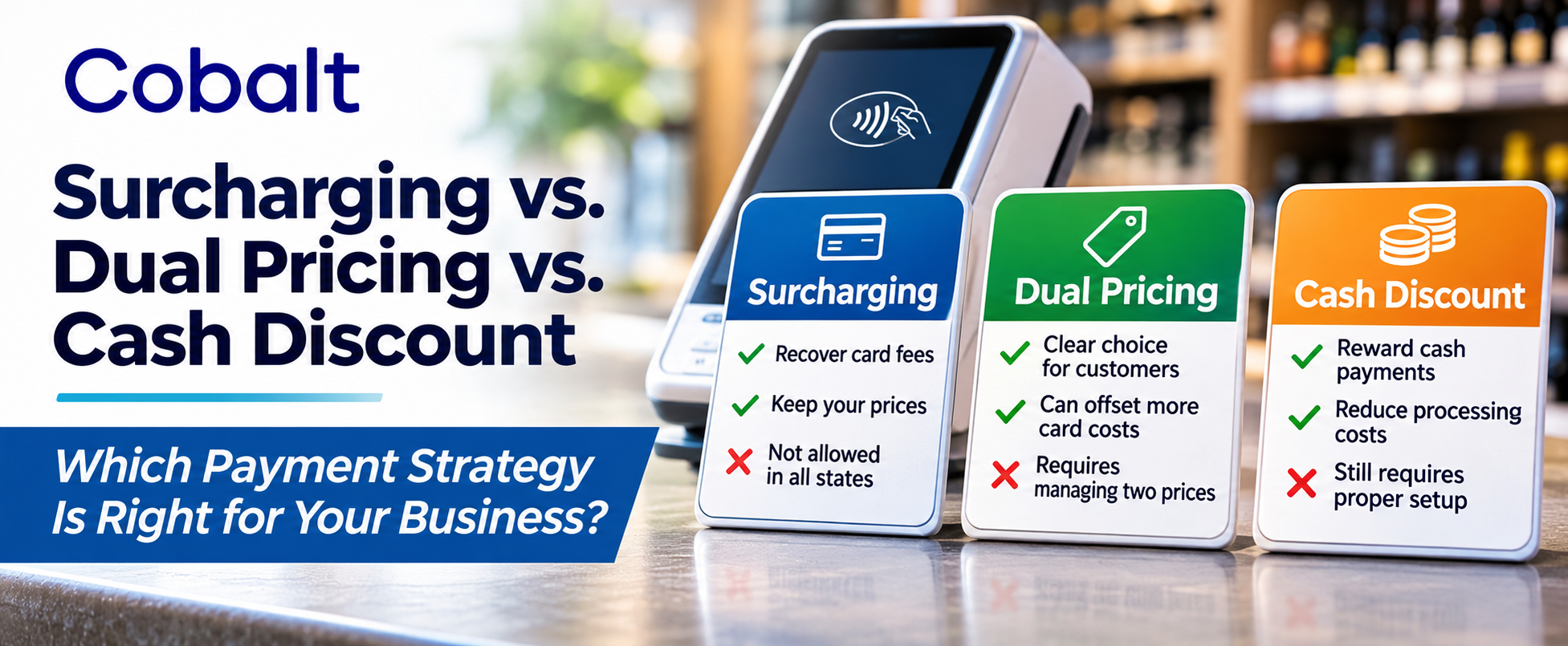
Dual Pricing:
A business clearly presents
cash and card prices,
allowing customers to choose
between payment options.
Cash Discount Programs:
Customers receive a genuine
discount from the regular
posted price when paying cash.
Credit Card Surcharging:
Where legally permitted,
a business may recover
eligible credit card acceptance
costs through a properly
disclosed surcharge.
Each approach has advantages,
limitations, and compliance
requirements.
For example, Visa and Mastercard
prohibit surcharging debit
and prepaid cards.
State laws may also restrict
credit card surcharges
or impose additional requirements.
The best solution depends
on the merchant’s location,
card mix, customers,
processing volume,
and operational requirements.
Important Compliance Reminder:
Dual pricing, cash discounting,
and surcharging are not
interchangeable arrangements.
A program must be properly
structured, accurately disclosed,
and compliant with applicable
laws and card-network rules.
A business should verify
current requirements before
implementing a new pricing model.
How to Tell Whether You’re
Overpaying for Credit Card Processing
You do not need to be
a payment processing expert
to begin evaluating
your merchant statement.
Start by examining the following:
-
Total processing volume:
How much did your business
process in card payments? -
Total fees:
What was the complete
processing expense,
including recurring charges? -
Effective rate:
Divide total fees by
total processing volume. -
Credit and debit mix:
How much volume comes from
each payment type? -
Processor markup:
Can you identify the amount
charged by your provider? -
Recurring fees:
Are there services you
do not need or use? -
Rate changes:
Have your costs increased
without a clear explanation? -
Equipment obligations:
Are you leasing equipment
or paying unnecessary
monthly hardware fees?
The answers can help
you identify areas that
deserve closer attention.
However, comparing processing
offers accurately can require
more than looking at a
single percentage.
A meaningful comparison
should account for card mix,
transaction counts,
interchange costs,
processor markups,
and all recurring expenses.
What Could Lower Processing
Fees Mean for Your Business?
Let’s examine the potential
impact of reducing processing
expenses for businesses
with different monthly volumes.
The following examples assume
an effective rate reduction
from 3.25% to 2.50%.
| Monthly Card Volume | Monthly Savings | Annual Savings |
|---|---|---|
| $25,000 | $187.50 | $2,250 |
| $50,000 | $375 | $4,500 |
| $100,000 | $750 | $9,000 |
| $150,000 | $1,125 | $13,500 |
| $250,000 | $1,875 | $22,500 |
These are illustrative calculations,
not guaranteed savings or quoted
Cobalt Payments rates.
Actual results depend on
processing costs, card mix,
transaction patterns,
and available pricing.
The important point is that
even modest improvements
in payment processing costs
can produce meaningful
long-term financial benefits.
How Much Could Your Business Save?
Send Cobalt Payments your
current processing statement
and let us help identify
potential savings opportunities.
Call us at
860-270-0552
Five Questions Every Business Owner
Should Ask Their Payment Processor
Before signing a new agreement
or renewing an existing one,
ask these questions:
1. What Is My Actual Effective Rate?
Ask your processor to calculate
the total processing expense
as a percentage of your
card processing volume.
2. Which Fees Are Negotiable?
Find out which charges
represent interchange
and network assessments
and which are processor-controlled.
3. Will My Rates Change?
Ask how rate increases
are handled and how
you will be notified.
4. What Happens If I Cancel?
Understand cancellation
requirements, termination fees,
and equipment obligations.
5. Are There Better Pricing
Options for My Business?
Ask whether interchange-plus,
dual pricing, cash discounting,
or another arrangement
could improve your
overall profitability.
A processor should be able
to explain these topics
clearly and directly.
Why Transparency Matters More
Than the Lowest Advertised Rate
Choosing a payment processor
based solely on the lowest
advertised rate can be
a costly mistake.
The real value of a payment
processing relationship
depends on more than
a single percentage.
Business owners should also
consider:
- Transparent pricing
- Reliable payment equipment
- Responsive customer support
- Clear contract terms
- Accurate reporting
- Useful payment tools
- Predictable expenses
- Long-term service quality
A slightly lower processing
rate may provide little value
if the business experiences
frequent equipment problems,
poor support, or unexpected
account charges.
The goal should be
to find a provider that
delivers a competitive
overall cost while
supporting your business
as it grows.
How Cobalt Payments Helps
Businesses Reduce Processing Costs
At Cobalt Payments,
we believe merchants
deserve to understand
exactly what they are
paying for.
Our approach begins
with understanding
your business and
your existing processing
expenses.
Instead of focusing
only on an advertised
rate, we evaluate
the overall cost
of accepting payments.
Depending on your
business’s needs,
we can help you
explore options such as:
- Competitive traditional processing rates
- Interchange-plus pricing
- Dual pricing solutions
- Cash discount programs
- Compliant surcharging where permitted
- Payment terminals and POS equipment
- Virtual payment terminals
- Electronic invoices and payment links
- Recurring billing and installment options
We also believe
that customer support
should be straightforward
and accessible.
Cobalt Payments emphasizes
U.S.-based support and
long-term merchant
relationships rather
than confusing promotional
offers or unnecessary
contract complications.
Our objective is simple:
help businesses retain
more of the money
they earn while
providing reliable
payment solutions.
Frequently Asked Questions
About Credit Card Processing Fees
What Is a Good Credit Card
Processing Rate?
There is no single ideal
rate for every business.
The appropriate cost
depends on card mix,
transaction size,
industry, processing
method, and pricing model.
Can I Negotiate My
Processing Fees?
Many processor-controlled
fees and markups
may be negotiable.
However, interchange
and network assessment
rates are generally
established by the
applicable payment networks.
Why Is My Effective Rate
Higher Than My Quoted Rate?
Your quoted rate may
exclude interchange,
network assessments,
monthly fees,
or other charges.
Tiered pricing and
transaction mix
can also affect
your total expense.
Should I Choose Flat-Rate
or Interchange-Plus Pricing?
Flat-rate pricing
may provide simplicity
and predictable
transaction charges.
Interchange-plus
can offer greater
visibility into
underlying costs.
The better choice
depends on the
business’s volume,
card mix,
and complete fee structure.
Are Free Credit Card
Terminals Really Free?
Some providers offer
equipment at no
upfront charge.
However, merchants
should review whether
the offer requires
specific processing
terms, minimum volume,
or other commitments.
How Often Should I Review
My Processing Statement?
Reviewing statements
monthly can help
identify unusual fees,
unexpected rate changes,
and processing trends.
A more detailed
comparison of providers
may also be worthwhile
periodically.
Can Cobalt Payments Review
My Existing Statement?
Yes. Contact Cobalt Payments
to discuss a review
of your current
processing expenses
and potential alternatives.
Call 860-270-0552
or
request a free processing analysis online.
Final Thoughts: Don’t Let Hidden
Processing Costs Reduce Your Profits
Credit card processing
is a necessary part
of doing business,
but paying unnecessary
fees does not have
to be.
From tiered pricing
and processor markups
to equipment leases,
recurring account fees,
and unexpected rate
increases, there are
many reasons a merchant’s
actual expenses may
exceed expectations.
The first step toward
reducing those costs
is understanding
what you currently pay.
Once you understand
your effective rate,
transaction mix,
and processor markup,
you can make a
more informed decision
about whether your
existing arrangement
still makes sense.
You may discover
that your current
pricing is competitive.
Or you may identify
opportunities to
reduce expenses
without changing
the way your
customers pay.
Either way,
having the right
information puts
you in a stronger
position to protect
your business’s
profitability.
Find Out If You’re Paying
More Than You Should
You work hard
to generate revenue.
Make sure unnecessary
processing expenses
aren’t consuming
your profits.
Let Cobalt Payments
review your current
processing statement
and help determine
whether you could
benefit from lower
rates or a different
payment strategy.
Request Your Free Processing Statement Analysis
Prefer to speak with someone?
860-270-0552
Cobalt Payments
Transparent Pricing.
Reliable Support.
Better Payment Solutions.