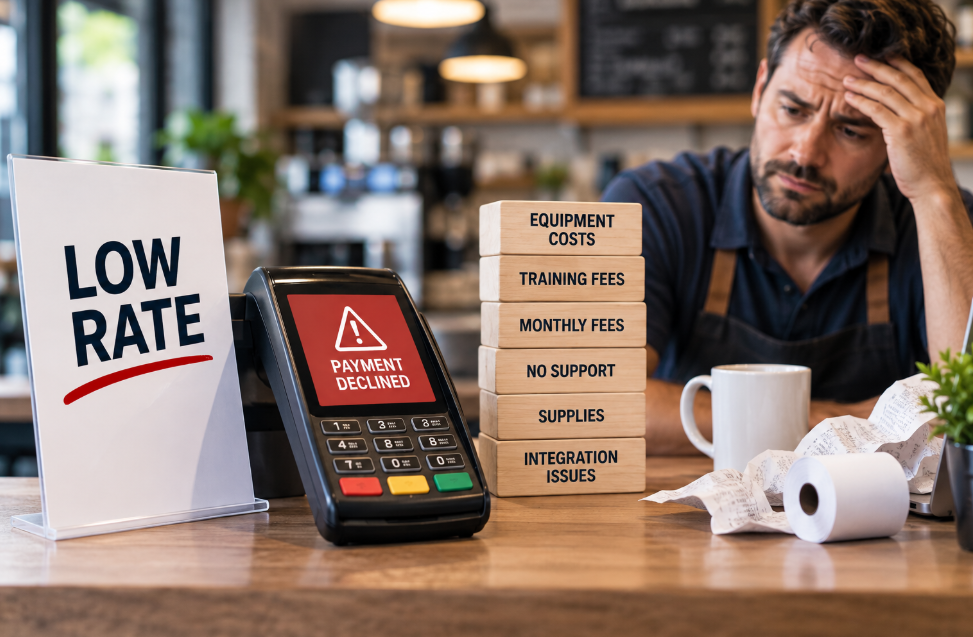
Don’t Fall for the FAKE Low Payment Processing Fees: How Some Payment Processors Win Your Business, Then Raise Your Costs
Free hardware and unbelievably low Payment Processing Fees can sound like an incredible deal. But before signing an agreement, business owners should understand how teaser pricing works and what the offer may really cost over time.
When shopping for a new payment processor, it is easy to get excited by offers that seem almost too good to be true.
- Free POS hardware
- Extremely low processing rates
- No upfront costs
- Promises to beat any competitor’s pricing
For many business owners, these offers sound like an easy decision.
Unfortunately, in many cases, they are what the payment processing industry refers to as teaser offers.
The attractive pricing shown during the sales process may not be the same pricing the business is paying three, six, or twelve months later.
At Cobalt Payments, we believe merchants deserve honesty, clarity, and transparency—not unpleasant surprises hidden inside a long-term agreement.
If It Sounds Too Good to Be True
Payment processing is a business with real operating costs.
Banks charge interchange fees. Card brands charge assessment fees. Hardware costs money to manufacture and distribute. Software requires ongoing development, security, maintenance, and customer support.
No legitimate company can continuously provide expensive hardware, extremely low processing rates, and full-service support while operating at a loss.
Eventually, that money has to come from somewhere.
Some providers recover those costs by:
- Raising processing rates after an introductory period
- Adding monthly service or platform fees
- Charging annual compliance fees
- Increasing PCI-related fees
- Adding statement, gateway, or batch fees
- Charging equipment lease payments
- Using long-term contracts with expensive cancellation penalties
Not every payment processor operates this way. However, these practices are common enough that every business owner should evaluate an offer carefully before signing.
The Problem With Saying “Yes” to Everything
Some payment processing salespeople are rewarded primarily for getting a merchant to sign an agreement.
That can create the wrong incentive.
Instead of honestly saying, “We cannot provide that offer sustainably,” a salesperson may simply say, “Yes, we can do that.”
The provider then finds another way to recover the cost after the agreement has been signed.
This can result in:
- Unexpected processing fees
- Higher effective rates
- Automatic contract renewals
- Expensive cancellation charges
- Equipment the merchant does not actually own
- Confusing monthly statements
Nobody wants to hear “no,” but a dishonest “yes” can cost a business far more in the long run.
Free Hardware Is Rarely Truly Free
Free hardware can be a legitimate promotion. However, business owners should understand how the payment processor plans to recover the cost of that equipment.
A provider giving away Clover systems, terminals, tablets, printers, scanners, or cash drawers is making a financial investment.
There is nothing inherently wrong with that. The important question is:
How is the payment processor planning to make that money back?
The answer should be clearly explained before the merchant signs an agreement.
Questions Every Business Should Ask
Is the processing rate permanent?
Ask whether the advertised rate is introductory pricing. If it is, find out exactly when it changes, what causes it to change, and how much the increase may be.
Is there a contract?
Ask how long the agreement lasts, whether it automatically renews, and whether there are early termination or cancellation fees.
Do I own the equipment?
Some merchants discover that the equipment they believed was free is actually leased or tied to a long-term processing agreement.
Ask:
- Who owns the hardware?
- Is there an equipment lease?
- Can the equipment be used with another processor?
- Is there a buyout amount?
- What happens to the equipment if the account is canceled?
What fees are not included in the advertised rate?
Ask for a complete list of every recurring and potential fee, including:
- PCI compliance fees
- Statement fees
- Monthly minimums
- Platform fees
- Gateway fees
- Batch fees
- Annual fees
- Customer support fees
- Equipment replacement fees
Can I see the complete pricing proposal in writing?
A transparent payment processor should be willing to clearly explain how the pricing works.
If the proposal is confusing, incomplete, or filled with vague language, do not sign until every question has been answered.
Review the Entire Agreement
Do not rely only on the sales presentation or the numbers written on the first page of a proposal.
Review the complete merchant agreement and look for:
- Introductory pricing language
- The processor’s right to change pricing
- Automatic renewal terms
- Early termination fees
- Liquidated damages clauses
- Equipment lease terms
- Monthly minimums
- Additional service fees
It is always better to ask difficult questions before signing than to discover the answers after the rates increase.
Transparency Should Be the Standard
At Cobalt Payments, we believe honesty is the foundation of a long-term business relationship.
That means we will tell you:
- What pricing is realistic
- What promotions are sustainable
- What fees may apply
- What equipment is included
- What contract terms you are accepting
- What is and is not possible
We will not say yes to every request simply to win your signature.
We will not trap your business in a three-year agreement and then rely on unexpected rate increases to make the numbers work.
Our goal is not simply to earn your business today. Our goal is to build a relationship that lasts because the pricing, service, and expectations were clear from the beginning.
The Cheapest Offer May Not Have the Lowest Cost
Choosing a payment processor based solely on the advertised rate can become expensive.
Business owners should compare:
- Total monthly cost
- Long-term pricing stability
- Contract terms
- Equipment ownership
- Customer support
- Cancellation policies
- Transparency
A slightly higher rate that remains consistent may cost far less than an unbelievably low teaser rate that increases after a few months.
Let Cobalt Payments Review Your Offer
If you are considering switching processors or recently received an offer that seems too good to be true, schedule a conversation with our team.
We will help you understand the rates, fees, contract terms, and total long-term cost of the proposal.
Schedule a Call With Cobalt Payments
No pressure. No gimmicks. Just straightforward information from a team that believes transparency matters.
“`